Latest update 6 January 2007
Below you will find an overview of the particulars of the different types of helmets in the US Navy H-series. More information about each individual type can be found using the menu to the left.
H-1
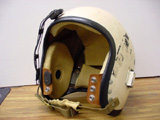
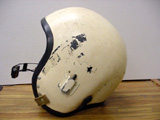
Far left: The H-1 had built-in earphones,
and leather oxygen mask tabs with three studs on each. Left: The H-1
helmet shell was of a unique shape angling in sharply behind the earphones, making it
appear almost flat at the rear.
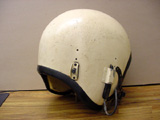
Right: The H-1 had a female microphone plug on each side of the shell;
one for a boom microphone and one for an
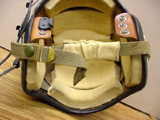
oxygen mask microphone, and a selector switch to change between the two. Far right:
The liner consisted of five
oblong foam blocks covered with chamois. Pictures © Milehigh
H-2
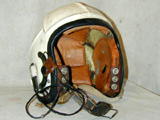
Far left: The H-2 had built-in earphones
and had the same type of liner as the H-1. Like the H-1 it was also fitted
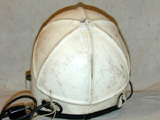
with leather oxygen mask tabs with three studs on each. Left: The
H-2 helmet shell had six radial reinforcing rid-
ges meeting in a star on the crown of the helmet. Another ridge ran horizontally around
the helmet, stepped up a
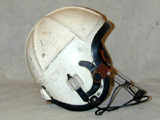
couple of centimetres in the two lateral panels. Right: The H-2 had the
same communications setup as the H-1 with
external female microphone plugs on each side and a selector switch on the right rear
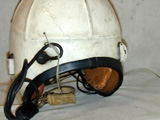
quarter. Far right: Rear
view showing the communications cord and microphone switch. Pictures © tom2991
H-3
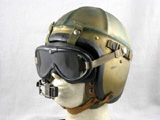
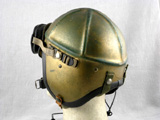
Far left and Left: The H-3
consisted of a cloth innerliner with all communications and oxygen mask attachment
facilities and a separate outer hardshell. The outer shell had the same general appearance
as the H-2 with reinfor-
cing ridges but the horizontal ridge went around the helmet in an unbroken line. Right:
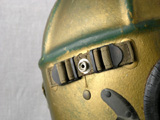
The outer shell had a new
type of liner, a strap suspension assembly. Two buckles on each side on the helmet shell
allowed the wearer to
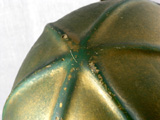
adjust both frontal and rear part of the headband. Far right: The six
reinforcing ridges met in a star on the crown
of the helmet shell; just like the H-2. Pictures © Bluelight
H-4
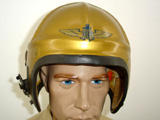
Far left: The H-3 and H-4 helmets are very
often confused but there are clear differences. The brow area of the
H-4 helmet was lowered in comparison with the H-3 helmet, and this gave the latter a
"heavier" appearance, both
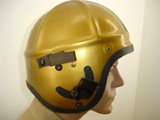
when seen from the front and from the sides. Left: Like the H-3, the H-4
consisted of a cloth inner liner and a separate outer hardshell. The strap suspension assembly was changed from the H-3 in that only
the rear part of the
headband was adjustable. The external adjustment strap was therefore shorter and placed
further to the rear.
Note also the raised area around the rivet above the face opening curvature; another
feature where the H-4 differed
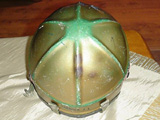
from the H-3. Right: The six reinforcing ridges met in a round elevated
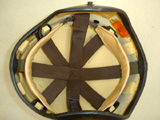
area on the crown of the helmet shell. Far right: Inside of the outer hardshell showing the strap
suspension assembly and the lack of communication gear.
Pictures of the factory-fresh H-4 are courtesy of Peter Bennethum©
"flightjkt" and the top view is ©
jstlook777
H-5

Far left: The H-5 helmet saw a return to
the one-piece helmet where communications gear and liner were fitted
into the same helmet shell. Left: The shell was of a new design without
reinforcing edges. The H-5 still had external
buckles for adjusting the rear half of the headband. Middle: The raised
area around the rivet and the protruding
frontal edge in the brow area are reminiscent of the H-4 outer shell. Right:
An inside view showing the strap sus-
pension assembly and earphones. The leather oxygen mask tabs hod only two studs on each,
as was the case for
the H-4 innerliner and the APH-5 helmet. Far right: Gentex label from H-5
helmet. Pictures © DocBoink
H-X (or whatever it is called)
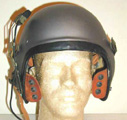
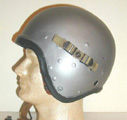
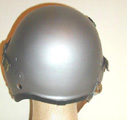
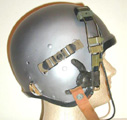
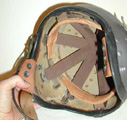
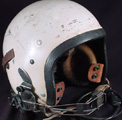
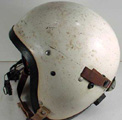
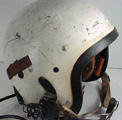
This helmet, called H-X here for lack of a better
designation, might to be an early prototype of what became the
H-5, most likely developed in parallel with or maybe even prior to the H-4. It might also
be a rigger-made mix but
only further research will answer that question. The shell is the same as the H-5 but the
communications setup and
oxygen mask tabs with three studs each are like the ones used on the H-2. The strap
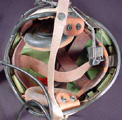
suspension assembly with
adjustable front and rear headband halves is like the one used on the H-3 with two
external adjustment buckles on
each side of the helmet. A couple of factors confuse the prototype theory. The grey foam
liner looks like the one
used in the Gentex MC-1 series of CVC helmets, and the nape strap looks like the one used
on the Gentex APH-5A
US Army quartermaster flight helmet. Pictures © DocBoink.