Latest update 6 January 2007
The H-2 helmet was developed around 1949 as one of two
helmet concepts for replacing the H-1. One concept followed the same philosophy as the H-1
where impact resistance, liner, communications and oxygen attachment were integrated into
one helmet. This became the H-2. The other concept followed the idea of a two-piece helmet
where a cloth liner carried communications and oxygen mask attachment and a separate outer
hard shell provided impact resistance. This became the H-3 helmet. The H-3 plus liner
concept appeared to be a more promising answer so the became a parenthesis only. Not much
is known about the H-2 service history. Photograpic evidence shows that it was used in
some fleet and marine squadrons in the 1951-1954 timeframe and may have been used by
individuals even later.
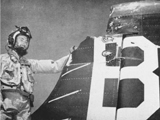
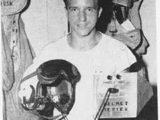
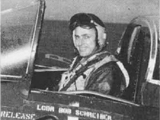
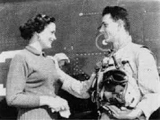
Far left: Lt.j.g. Edward Phillips, a
Skyraider pilot from CAG-19 onboard USS Princeton in May 1951 wearing what
appears to be an H-2 helmet. Naval Aviation News (NAN) July 1951. Left:
Sgt. J.A. Lovullo from VMF-323 with an
H-2 helmet hooked up to a helmet tester. NAN December 1952. Right: Ldcr
Bob Schreiber, Commanding Officer
of VF-194 wearing an H-2 helmet. NAN July 1952. Far right: Lt.j.g. Otto
Krueger from VX-5 holding an H-2 helmet.
NAN July 1954. All pictures © US Navy
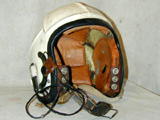
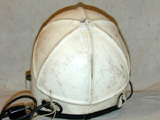
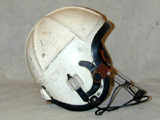
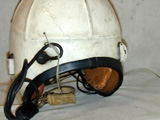
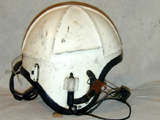
Far left: The H-2 had built-in earphones
and had the same type of liner as the H-1. Like the H-1 it was also fitted
with leather oxygen mask tabs with three studs on each. Left: The
H-2 helmet shell had six radial reinforcing rid-
ges meeting in a star on the crown of the helmet. Another ridge ran horizontally around
the helmet, stepped up a
couple of centimetres in the two lateral panels. Right: The H-2 had the
same communications setup as the H-1 with
external female microphone plugs on each side and a selector switch on the right rear
quarter. Far right: Rear
view showing the communications cord and microphone switch. Pictures © tom2991
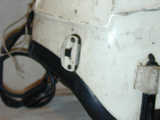
Far left and Left:
Pictures showing more of the communications setup including the microphone selector
switch.
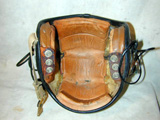
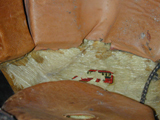
Right: The liner with its leather-covered rubber foam pads. Far
right: The remains of the manufacturer's label.
Pictures © tom2991
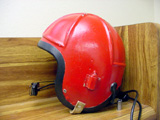
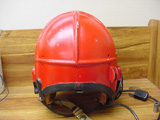
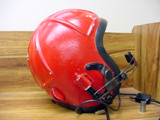
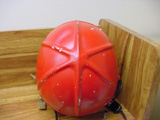
Most likely a late H-2 showing variations in the shell
configuration. The horizontal reinforcing ridge is missing on the
right and left sides, and on the crown of the helmet the area where the six ridges meet is
larger, reminiscent of the
H-4 helmet. Pictures © Milehigh.
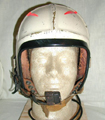
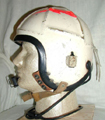
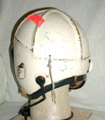
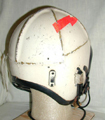
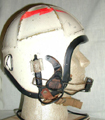
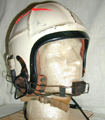
H-2 helmet with day-glo red lightning bolts. It is unclear
what the purpose is of the nylon cord hanging from the rear
left side. Pictures © DocBoink.
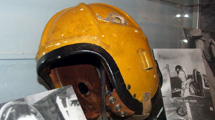
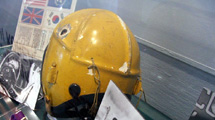
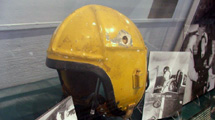
H-2 helmet displayed at the Naval Air Museum in Pensacola.
Judging from the display it belonged to a Lt.j.g. Paul
Cooper but I am unaware of the story behind it. Pictures © Shark