Message 3550, Jul 22, 2001
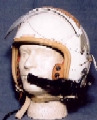
As promised I hereby post a photo of a Danish P-4 helmet with clear visor as used by
police observers. The green badge on the helmet is the Royal Danish Police badge. The
clear visor is a modified HGU-26 visor where the knob has been cut off. A neoprene list
has been glued to the upper rim in order to make the visor edge thick enough for the P-4
visor yoke to get a proper grip. The black neoprene is visible in the visor yoke slot.
Cheers,
Bluelight
Message 3503, Jul 20, 2001
Interesting information on the visors, Bluelight. Will look forward to some photographs
when circumstances and time constraints permit. Welcome back from holiday!
Cheers, DocBoink
Message 3492, Jul 19, 2001
Hi DocBoink, Maggot et al, The clear visors used in Denmark were modified HGU-visors.
Additional material had to be glued to the top edge of the visor, otherwise the visor yoke
could not hold on to the visor glass. I will post a picture once I have everything sorted
out from my Denmark-trip.
Cheers, Bluelight
Message 3490, Jul 19, 2001
Hi Maggot, I took the same sort of hard look at that P-helmet and its strange visor. You
may in fact be correct in stating that it APPEARS as if someone took an HGU or APH-type
clear visor and jury-rigged it to the P-helmet's visor yoke. It would serve as a bird
strike visor, but the angulation from brow of helmet to bridge of nose is all wrong
(further evidence that this is a later helmet visor, rather than something that was
originally intended to go with a P-series helmet). Cheers, DocBoink
Message 3489, Jul 18, 2001
I'd have sworn that's a tacked on APH-5 or HGU-2 clear visor (if there was such an animal)
- am I seeing things or does it look like there's a "tooth" on the clear visor
in the side view of the helmet? It also has a decidedly "hacked" look from the
side view - visor cou\ntour completely different than what one would expect from a clear
"P" helmet visor...
Maggot
Message 3487, Jul 18, 2001
Hi, I think the helmet is a nice complete P 4 type, and the clear lens is the original one
used during night flight to avoid severe occurrence in case of bird strike, I have one of
this lens with the USAF spec. number similar to that assigned to the normal type.
best regard, Horrido
Message 3465, Jul 17, 2001
Hi Pilot, Looks pretty OK to me. The only "funny" thing is the clear visor as
these helmets always were fitted with a dark visor.
The Royal Danish Air Force used a similar modification for police observers who
predominantly participated in low-level flights. Due to the bird strike risk all Danish
pilots and crew members must wear a visor at all times. For fighters we had introduced
double-visor helmets but for budgetary reasons other flying personnel used the old P-4
helmets. The P-4 could only take one visor but a dark visor would be a pain for low-level
work especially in Denmark with its often cloudy or rainy weather, so the solution was a
clear visor plus a pair of HGU-4/P sunglasses.
In conclusion, the helmet is not as originally issued but may very well be service
original.
Cheers, Bluelight
--- In flightgear@y..., Pilot <pilot@u...> wrote:
eBay item 1167833730 (a P-4 helmet with clear visor); A very nice looking helmet...could
anyone tell me if it is a fair example of the helmet and do the components look
authenthic. I know almost nothing about the early examples of flight helmets.
Pilot
Message 3020, Jun 19, 2001
Hi Maggot, I'll have to go along with Rich on this and opt for the lower spring. Although,
as has been pointed out, when the springs are attached (and stretched out a bit), the
"resting" unloaded length becomes sort of academic. The attachment loops on the
end are different from the original, but they could probably be 'teased' a bit into a
somewhat more authentic shape (if one was that particular about it). Most of the springs
in actual use acquired a patina of oxidation, but that could be induced by soaking them in
water for a few days and letting them dry in direct sunlight. It's a close 'coil' between
the two alternatives, however (heh-heh).
Cheers, DocBoink
Message 3018, Jun 18, 2001
My opinion is the shorter looks a little more original - once they get stretched and
hooked up, one has a hard time telling the difference. The one with the correct length
(bottom) has a different shape to the hook end - more circular than a flattened oval.
Splitting hairs to the Nth degree, Maggot
Message 3014, Jun 18, 2001
I think the bottom spring would acquire the proper patina if left out in the weather a
while! Much more convincing than the short one.
Rich
Message 3012, Jun 18, 2001
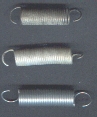
Here is what I have without too much digging: The middle spring is an original P-helmet
visor frame type. The UPPER one was obtained through a local aircraft parts supply house
(a couple years since I've been back there). The lower one... well, let's just say they're
from another aircraft parts supply place ;-)
The upper one has the same crusty anodized look, but is a few turns shorter. The lower one
is shiny new, same length, but a slight difference in the hook on each end.
Any thoughts? Maggot
Message 3004, Jun 18, 2001
Hi Maggot, Sounds like a plan. The local hardware stores carry a line of springs that come
verrrrry close--but not close enough to pass undetected. The search continues, but
meanwhile it would be good to see what you have there on that end, for a suggested
comparison. Thanks.
Cheers, DocBoink
Message 3003, Jun 18, 2001
I may still have a local aircraft hardware source which I have utilized for P-helmet
replacement springs... they are not "bang on" but come pretty darn close - I
have a hard time discerning them unless I have an original example sitting right next to
it. will see if I can get some and we'll do a comparison here on site - you can tell me
what you think.
Maggot
Message 3002, Jun 18, 2001
Ahahahahahahahahahahahahahahahaha! You spotted the springs! That is damned near amazing,
Rich. I have to credit you with exceptional discriminatory abilities. You must have
magnified the images and inspected that detail very closely, as probably only one or two
others on the forum might have noted the fact that these are not originals (as you
stated), but very near approximations. They are there only to maintain the visor in its
retracted position until such time that I can find another original to mate up with the
single original I have here.
Kudos to you for being Eagle-eyed (you definitely passed whatever test this might have
been, but wasn't!). I'm posting this exchange on the forum, as it is a genuine credit to
your discernment, vis-a-vis an eye for authenticity. We need more of this, I think, not
less! There is a way to cast the rubber booties for the mic jack connectors, I am sure,
but I have a few extra originals here, so that won't be a problem. I just haven't gotten
to that part of the project yet, as with the nape strap, the wire loom, and the chin
strap.
Cheers, Chris
----- Original Message -----
> Your P-4 looks good, but if you could locate a
> source for original visor springs that would be
> even better. It is interesting that only the P-4
> (in my experience) used washers under the
> headphone assembly mounting screws.
> Rich
Message 2250, May 12, 2001
I found references to an interesting USAF Technical Report dated July 1953, titled
"Windblast Visor for P-1 Helmet and A-13A Oxygen Masks" studies. I'll give you
more information on this Tuesday, after I return. I expect it gives important background
on developments that led to the use of the 'new' early style side-latch visor (such as
Rich has on his "P-2"), and could be a most important recovery of information
(if I can ever figure out how to locate it).
Cheers, DocBoink
Message 2075, May 4, 2001
Bones, I bet that film you refer to is one and the same that Rich mentioned he had seen.
More evidence stacks up on the interesting history of the P-1 helmet, eh? Thanks for these
additional recollections and information!
Cheers, DocBoink
Message 2070, May 4, 2001
Greetings All, I found where I saw that visor with the pierced rail. The original source
is obviously a training film. Maybe the same one that Rich referred to, but this one is
the F-86A (or possibly a very early E). It has a fibreglass nose piece, but a flat wind
screen. The helmet, that is painted red, very clearly shows this visor rail with the
holes, as in the TO, and the first pattern (non J) locking slot. This has to date from the
early 50's, maybe 1950 or 51, no later than 1952, unless he is a civilian pilot. The pilot
is wearing the K-1 (khaki) flight suit, and brown boots. Brown was no longer allowed in
the USAF after June of 1952. Black was introduced in 1949. If anyone has the video that
came out a few years ago, titled "the F-86" in the "Great Planes
Series" this training film is shown in part, and is probably easier to get than the
original film.
Bones
Message 2044, May 1, 2001
Bones, you are indeed a true devotee of this flightgear biz. Your sainted wife has my most
sincere sympathies, of course, but this is HOT STUFF! My own sainted wife (Saint Irene, by
name) is also quite familiar with that crazed look and fevered brow you reference,
heh-heh). A little catalyst now and then appears to be good, in terms of stimulating
parallel thoughts that may produce yet another gem of information, drawn out from its dim
cavern of shaded recollection! Go with it! (And please keep us apprised!).
Cheers, DocBoink
Message 2043, May 1, 2001
Greetings all
DocBoink you have done it again!!!. Fantastic info. It has stirred a memory in me, and has
pushed me to a new fury of insanity. I HAVE SEEN THAT VISOR SOMEWHERE!!! Operationally.
I cannot remember where, but I will look. Kathy has that look, like she wants to go hide,
when I go manic like this looking for something. Keep up the great work
Bones
Message 2035, Apr 30, 2001
Bluelight,
As regards the perforated visor yoke that you reference, I too was puzzled by this until I
rechecked all the early TO illustrations for P-1A through P-3. [As Steve has pointed out,
these were graciously 'loaned' to me, so I am really not at liberty to distribute them
(pending his approval & consequent completion of the book he is preparing on these
matters), however, the more eyes that scan them in theory, the better our assessments
would be of precisely defining and redefining their mandates]. What I found was that all
the early TO illustrations show this same perforated outer visor yoke bar in use.
This was also confirmed by Rich yesterday, after he spotted the scanned image I posted
from a TO and mentioned the fact that a very early Air Force training film he has (early
50s), showing USAF F-86D pilots in their contemporary flight gear, also clearly showed
them with this perforated visor yoke on their helmets. This was a welcome additional
verification of this very early visor mounting system.
I cannot figure out what the purpose of the drilling out of this piece would be, unless it
were a somewhat more hopeful than functional weight reduction scheme. Apparently, however,
it lost out to the solid aluminium outer yoke that we are familiar with at a fairly early
date. As to whether or not it made it to Denmark (or Yugoslavia, or any other NATO nation)
is a question I have no answer to.
Cheers, DocBoink
Message 2027, Apr 30, 2001
Hi DocBoink,
Thank you for your very elaborate insight into the P-helmet visor question. We can always
trust you to provide the longest postings on flightgear. Luckily, as it turns out they are
also some of the most interesting, to me at least.
I am left with two questions after your two visor postings. Firstly; does any of you have
an example of the perforated visor yoke shown in the scannings from the T.O.? The visor
yoke on Rich's "P-2" is made out of solid aluminium as far I can see. (I take it
that you did not add the holes yourself, Doc, as they were not in blue?).
Secondly; what kind of information might pop up from the P-series helmet T.O.s if a fresh
pair of eyes were to peruse them? I would humbly volunteer to give it a go if you would
provide me with photocopies of the relevant T.O.s (this is of course a sincere offer in
the interest of science - not a shrewd attempt to lay my mitts on a number of T.O. for my
personal collection).
Cheers, Bluelight
Message 2025, Apr 30, 2001
Gentlemen:
One last bit of additional information, specific to the previous email message dated
earlier today (29 Apr 01) and also to an original question posed by Bluelight, follows.
There were (at least) two different sets of helmet pivot-pin plates used on the P-series
helmets, for visor mounting purposes: an original set, designed with a pin on the
uppermost part of the plate to act as a retracted visor yoke stop and specific to use with
the "Early Visor, Type Original", and a later set, essentially identical in
almost every respect to the former, but without the upper protruding pin. These two set of
plates were TO'd roughly in 1951 and 1956. The PNs for the original pivot-pin plates were
PN 51C3634R (right side), and PN 51C3634L (left side). The PNs for the latter set of
pivot-pin plates were PN 56C3511R (right side), and PN 56C3511L (left side).
The fact that all early P-series helmets (P-1 through P-3) had these plates exchanged when
the new TO mandated them was distributed probably accounts for the fact that so few
helmets are found today with the original type pivot-pin plates still attached. Rich May's
"P-2" helmet would appear to have one of these extremely rare surviving examples
of the early visor mounting plates.
Cheers, DocBoink
Message 2018, Apr 29, 2001
Gentlemen,
I am sure you all have moments, late at night, when the proverbial light bulb flashes on
in one's cerebral cortex, as a truly GREAT realisation comes into sharp and exciting
focus. Sometimes this takes a more mundane form, such as a dawning awareness that that
cute brunette you have always viewed wistfully from afar ACTUALLY likes you! At other
times, it takes the upsetting form of an acute understanding that everything you formerly
assumed true was wrong and an overall corrective reassessment is in order.
In this particular instance, the awareness that my theories on the evolution of the USAF
P-series visors needed modification struck me at about 2AM, resulting in a definite lack
of sleep as one idea piled into another with the rapidity of one AMTRAK train trying to
simultaneously occupy the same space as another (coming from the opposing direction on the
same set of rails).
The trigger for this flash of insight was a protracted conversation I had a few months ago
with Rich Mays on certain aspects of his ostensible "P-2" helmet specimen. In
discussing this endlessly fascinating conundrum, part of our exchange centered on the
visor that his helmet had affixed to it. [As you will recall from several earlier
discussions of this subject, an assumption had been made (on my part, admittedly) that the
original hard external visor fitted to the early P-1A helmet had certain specific
identifying characteristics that clearly identified it as being different from the later
version. In conversations with Bluelight on the matter of visor nomenclature standards, it
was suggested that this erstwhile "earliest" P-series visor (with prominent
uppermost visor bar lift/grasp flange and short side-latching "J-arms") be
uniformly referred to as "Early Visor, Type 1", whereas the subsequent (it was
thought) "early" (or pre-centertrack), sidelatching visor (with longer
"J-arms" and no top-mounted grasp/lift flange) be referred to as "Early
Visor, Type 2" (the last visor version, used on P-4A and P-4B helmets was and will
continue to be referred to as the "Centertrack Visor").] Rich's helmet, which
appears to actually be an early 'Type 1' (the original USAF "Helmet, Flying,
Protective Type 1", more commonly known as the "P-1") helmet fitted with a
visor, has a head sling clearly machine-labeled "P-2". One of the theories
involving this helmet of Rich's is that it is an original P-1 helmet that had had (for
unknown reasons) a "P-2" head sling installed in it (the USAF P-2 helmet remains
a semi-mythical beast, with only fleeting references to it in Wright-Patterson AFB aerolab
technical literature and a few very poor photocopies of a two-part--soft inner and hard
outer shell--assembly that is clearly labeled a "P-2 helmet" to document its
existence). At any rate, in examining some images Rich provided of certain details of it,
I noted what appeared to be a peculiar and previously unknown (to me) visor side-latch
mechanism and helmet mount (rounded triangular pivot-pin plate, similar to those used on
all P-series helmets for this hard external visor). My explanation of it was that this
hitherto unknown side-latch and pin-plate assembly was a subsequent modification of the
"Early Visor, Type 1" assembly, possibly a modification rendered with a hack-saw
(to cut off part of the short-arm "J" catch mechanism), used with a pivot-pin
plate that had had an additional pin added to it's uppermost edge for use with this
particular bar. My inference was that this visor on Rich's helmet was an experimental
'one-off' attempt to improve the plainly less-than-ideal early side-latch visor
mechanism's functioning.
OK, cut to the chase.... Yesterday, I was perusing the stack of early P-series Technical
Orders covering this early class of USAF helmet (TO 13-1-37, later rescinded and
redesignated TO 14P3-4-1) and ran across a picture of this 'one-off' visor bar mechanism
(such as is installed on Rich's "P-2") right there in this early TO, clear as
day. Further searching showed that this same "No-J-arm" side-latch mechanism
appears in several different P-series TOs dated within the 1951 to 1952 period!
Furthermore, the pivot-pin plate displayed in these TOs in use with the "No
J-arm" visor side-latch bar is identical to that mounted on Rich's hypothetical
"P-2" specimen.
Breakthrough! 1) My preliminary assumption on the original form of the P-series visor
appeared to be all wrong and the erstwhile "Early Visor, Type 1" was not the
original design, after all. The "No J-arm" side latch assembly, with its top
pinned helmet mounting plates (as clearly installed on Rich's "P-2" example),
seems now to have been the first and original hard external visor assembly (not the
"Early Visor, Type 1"); 2) Rich therefore appears to have a helmet specimen that
has the only surviving example I have seen to date of this ORIGINAL "No J-arm"
visor design; 3) A redesignation of reference standard nomenclatural terms for describing
these visor assemblies is definitely in order, resulting therefrom.
And so, thus somewhat humbled and contrite (no small order for DocBoink, who definitely
doesn't like to feel contrite or humble), I offer up these revised terms which I would
suggest we use to refer to the P-series visors (until the next startling bit of
informational insight breakthrough changes these neat little assumptions again, eh?):
1) "Early Visor, Type Original" (describing the "No J-arm" side latch mechanism and corresponding top pivot-pinned helmet mounting plate, which were apparently the first to be used on any P-series helmet).
2) "Early Visor, Type 1" (describing the "Short J-arm" side latch mechanism and it's corresponding bottom pivot-pin helmet mounting plate as used with all subsequent visors, up through and including the last "centertrack visor" system).
3) "Early Visor, Type 2" (describing the "Long J-arm" side latch mechanism).
4) "Centertrack Visor" (initiated on P-4A type helmets and used up through the final P-4B variant of the P-series).
5) "Toptex Type Visor" (although not part of the P-series helmets as such, still worthy of inclusion in this reference nomenclature due to its importance as the only other USAF acceptable system in use by that service; this doesn't address or consider any USN or US Army variants).
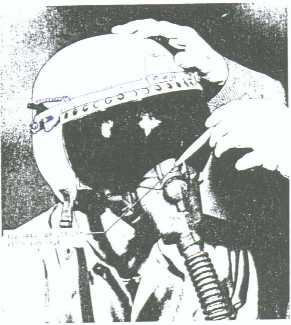
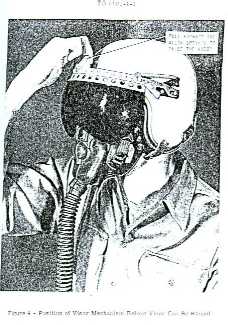
Please refer to the poor but acceptable scan of the "Early Visor, Type
Original", taken from USAF TO 13-1-37, dated 1951, for a diagram of this newly
'rediscovered' missing link in the hard P-series visor chronology to date.
Further notes: Again in deference to the usefulness of using a standard set of terms to
refer to critical component items found on the P-series helmets, I would strongly suggest
that the following terms found in the relevant USAF technical orders be adopted in our
future discussions along these lines. These TO publications commonly refer to the P-series
hard external visor bar as a "visor yoke" and the original leather oxygen mask
attachments as "oxygen mask tabs". The P-type head suspension assembly is
referred to collectively in the TOs as the "helmet headband" and "sling
assembly", so "headband & sling" should suffice as a standard term of
reference for our purposes.
Of additional interest is the fact that the early visor yoke (nee visor bar) for all
P-series helmets consists of two-component aluminum bow-shaped ellipses--an inner piece
and an outer piece. Whereas there was only a single standard size inner bow component for
standard size early P-series helmets (small & large for P-1A/B types--the original P-1
was made in only one size), there were two differently sized outer bow pieces. This was
intended to allow use of the regular three different sizes of hard visors (with the same
basic yoke assembly). If you have an early P-series visor yoke whose inner and outer bow
parts do not seem to fit together quite well enough, perhaps it is because someone
inadvertently mismatched an incorrectly sized outer bow component to the inner bow. The
yoke assembly PNs for the small size and large size P helmets were designated in the
relevant TOs as Visor Assembly PN 51C3632-1 (consisting of inner yoke bow PN 51C3636 and
outer yoke bow PN 51C3637) and Visor Assembly PN 51C3632-2 respectively. Visors (the
shaded transparencies) themselves were specified in three distinct sizes, given as being
PN 51D3643-1 Size Small, PN 51D3643-2 Size Medium, and PN 51D3643-3 Size Large. The TO
this reference is taken from is TO 13-1-40, dated 1953, but in seeming support of the fact
that USAF component upgrades and designations could be TERRIBLY confusing at times (even
to the officials who issued and printed the TO specs), the same specifications for visors
are rendered in reverse order in the later (updated) TO 14P3-4-1, dated 16 Aug 1957 (PN
51D3643-1 Size Large, PN 51D3643-2 Size Medium, and PN 51D3643-3 Size Small!). Much later,
the visor yoke assembly was changed and redesignated (different from the original assembly
specs--not the same as earlier type) for the "Centertrack Visor" as PN 56C3520-1
Visor Mechanism Small and PN 56C3520-2 Visor Mechanism Large.
One final additional observation on the early visor yoke "grab/lift" flange:
The "Early Visor, Type Original" yoke had a flange that was attached to the yoke
outer bow with two rivets. Only on the following "Early Visor, Type 1" yoke was
this flange cast integrally with the aluminium outer yoke bow itself. On the final
"Early Visor, Type 2", this grab/lift flange was eliminated altogether (or sawed
off of the bow) to eliminate this protrusion as a potential source for parachute riser
shroud-line fouling on high-speed egress.
In closing, as many of you know, recent months have seen the importation of some rather
excellent examples of the P-3 type helmets used by the ex-Yugoslavian Air Force (courtesy
of Serbian Miroslav Sekulic). These helmets consist of two main groups: 1) Actual US
manufactured P-3 helmets that were imported by Yugoslavia in the 50s and used by their Air
Forces with minor modifications (communications, etc.); 2) Yugoslavian license-made
versions of the US P-3 helmet, manufactured in the early to mid-1980s, designated the
Yugoslavian PK-07 Flight Helmet. While the earlier group were flown, but may be obtained
today in very good condition (they were apparently either little used or well maintained),
the later PK-07 examples that are also available were not ever flown and are consequently
in excellent, unflown condition (although they do have some 'shelf wear' and bear other
small blemishes and marks from storage). One of the side benefits of having access to
these recidivist 'throwbacks' to the 50s, is a chance to compare them to surviving USAF
flown specimens of the early 50s. Small details such as the riveted grab/lift flange on
the (1980s manufactured) Yugoslav helmets stand out as original design details that as
such are not found on most (updated) US versions that have survived today.
Hence, whether you limit your interest in helmets (as some American collectors do) to US
made and used helmets only, there is still much to be learned about American helmets
through such comparisons as these with foreign copies or foreign-made versions of certain
models. I personally have gained a great deal of insight and enhanced understanding of the
ever-confusing details of US P-series helmet history through my own examinations of some
of Miroslav's excellent offerings.
The attached images show poor but viewable reproductions of two illustrations taken from
the early USAF TO illustrating the above referenced "Early Visor, Type Original"
and a close-up photographic shot of that system's "No J-arm" side-latch visor
mechanism, as found on Rich May's "P-2" helmet specimen (pardon my rude
enhancements drawn with blue pen to make details stand out and thanks to Rich for use of
his image). It should be pointed out that Rich's helmet's visor also features an odd,
presumably experimental grab/lift flange on it that was probably proposed and
hand-fabricated, then added to Rich's helmet's conventional "Early Visor, Type
Original" for purposes of testing & study.
So, what does all this tell us on this beautiful sunny day (at least it is here) about the
endlessly interesting old USAF P-series helmets? Simply this: 1) Never, ever accept it as
gospel that the final chapter on anything has been written when it comes to any aspect of
life support and flight gear history! 2) Even the official USAF TOs can be dead wrong, at
times. Happy collecting to all.
Cheers, (a long-winded but hopefully helpful) DocBoink
Message 1220:
Hi Bluelight 14, As far as I have ever been able to determine, the standard rounded &
semi-triangular P-helmet attachment plates remained exactly the same throughout the
service period they were in use--I have no information, TOs or actual specimens, that bear
testimony otherwise or to the contrary. Cheers, DocBoink
Message 1215:
Hi DocBoink, Very useful indeed, thanks. What about the visor mounting plates that were
attached to the helmet sides? Did they vary over the years or did all three visor types
fit the same type of plate? Cheers, Bluelight 14
Message 1188:
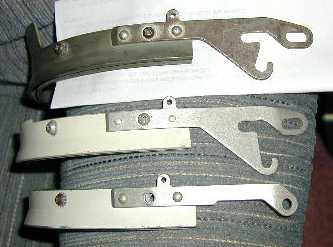
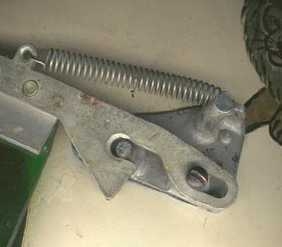
The attached three photos may be of interest, but the information applies only to
American helmet in USAF service (not to foreign P-series types, in which variations may be
encountered).
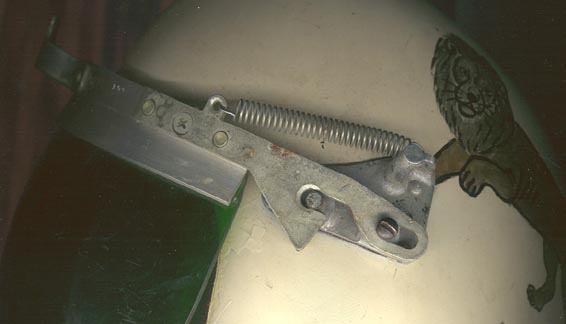
The first photo shows the three principal P-helmet visor bars, stacked
vertically for a visual comparison. On top is an example of the very earliest production
visor bar (known commonly as the "side-latch"), as fitted to P-1A, P-1B, P-3
helmets. The second, or middle bar, shows the immediate successor, a later version of the
"side-latch" that was retrofitted on some of the earlier P-series helmets, but
most often found on late production P-3 and all production P-4 helmets. The third, or
bottom, bar is the type used on all P-4A and P-4B helmets, equipped with the last
("center-track") P-helmet visor mount.
Compare this first photo with the second one, which shows the modified visor bar found on
Rich May's unique Wright-Pat mystery helmet (with P-2 sling label). A comparison with the
uppermost bar shows that it is most likely a cut-off modification of this early bar's
side-latch "J" arm (the helmet mount plates were modified accordingly, as
well--look at the photo closely).
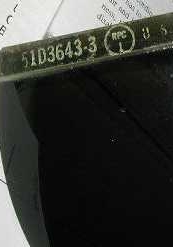
Finally, FYI, all P-series helmet visors themselves came in three standard sizes:
Small (# 51D3643-1), Medium (51D3643-2), and Large (51D3643-3). The helmet visor bars
themselves came in two sizes, to the best of my knowledge (at least; possibly
three--anyone ever seen a "Large" or -3 bar? I have not). Both the early side
latch visor bar and the later side-latch bar size identification numbers were
identical, despite the small change in the "J" arm hook length: Small
(51C3632-1) & Medium (51C3632-2) [and possibly Large (51C3632-3), but again this
in unconfirmed]. The last Center-track visor bar came in two, possibly three sizes: Small
(56C3520-1), Medium (56C3520-2) [and possibly also Large (56C3520-3) for the Extra-Large
size P-4A/B shell; the previous caveat applies here, as well].
Anyone having any evidence or proof of the existence of a size large visor bar (spec #
51C3632-3 or # 56C3520-3) please contact me so that I may modify my data
accordingly.
Contrary to logical supposition, the visors themselves were measured from top of nose
cutaway to the top of the uppermost center part of the visor and had no specific or direct
association with the helmet shell size or visor bar size. The visor bars were measured to
take shell size into account and the size -2 visor bar seems to have been used on all
larger later P-series helmets (with size 1 used on small size shells). Recall that the
early P-series helmet shells were only made in small and large sizes, with precise
sizing to individual pilot's heads achieved through adjustment of head sling lacing and
earphone positioning. The late model P-series helmets were also made in an extra-large
size (for watermelon heads, like me--and no, we're not talking about ego size
accommodations, here...ho-ho-ho). The third photo is a shot illustrating where the
visor identification number is printed on the upper, outer external edge of the visor in
white ink, on pilot's right (that would be your left, facing the visor).
Hope this information is helpful to those of you concerned with the P-series helmets.
Cheers, DocBoink
Message 1114:
Hi All, Another P- series modification came to light while studying my copies of French AF
manuals. The French have used (at some point in time (1957)) the P-3 series helmet. For
this helmet the French adapted their own visor kit. This looks like the American version,
but has a release handle on top. This visor kit is called the Type 541.1. made by
L'Optique Scientifique. The Type 541.2 and 541.3 also exist but were used on the Gueneau
Type 31 M1. Type 541.2 for the fighter pilot (visor at an 48 degree angle) and the Type
541.3 for the bomber/navigator (visor at an 70 degree angle). This has probably something
to do with the use of a mask. For the fact sheets see the attachment. Bye HUD
451.1 datasheet, 451.2 datasheet
Message 874:
Speaking of visors, I note that a visor on one of Rich's more interesting and somewhat
exotic P-helmets helmets appears to be somewhat of a prototype (similar to but different
from the original side-latch visor on the early P-series) design that is entirely new to
me; hence, there appears to be even more material on this subject that needs to be
researched. Cheers, DocBoink
Message 854:
As far as the P-series visors go, there are three distinct variations in the P-series
evolution. The VERY early (original) P-series visor featured two characteristic design
components that subtly set it off from the second version. Both of these early visors were
successive evolutions of what I have come to term the "side-latch" visor, in
that they were "center-trackless" and secured in an up-position by spring
activated auto-retraction and down through the positive engagement of the short
"J" arms (on the lateral aspects of the visor bar) onto the pins protruding from
the temporal helmet visor-mount fixtures. The differences between the initial 'side-latch'
visor and the successive version are to be found in 1) the protruding square metal flange
that was located at the very top rear of the visor bar, and in 2) the short throw of the
lateral "J" arms (about 1", versus 1&1/4" on the succeeding
version). The short throw of the "J" arms was found to result in the protrusion
of the lower visor edges in the upper peripheral field of the pilot's vision; this
constituted a slight, but significant visual distraction--not something, as the popularity
of the much later HGU-55/P helmet and the HGU-33/P cutaway visor-cover has borne out, that
pilot's welcome in hot air-combat mixers. Further, this protuberant upward thrusting
square flange on the visor bar, although intended to serve as a convenient gripping point
for visor actuation by hand, was found to snag on things (such as parachute riser shrouds)
and scratch canopies.
The second version of this original P-series visor came with this protuberant flange
removed (close examination of one such visor bar will reveal only a short stub, where the
flange used to be); furthermore, longer "J" arms on the side-latching mechanism
(about a quarter of an inch, but enough to do the job quite effectively) allowed the
retracted visor to secure in the open-position much higher on the helmet's forehead
section--this removing the offending lower visor field's peripheral distraction up and
away from the pilot's fields of vision. In the field, the early visor bars were frequently
modified with addition of the longer "J" arms and the upward thrusting
"grip" flange was filed off to a nub.
The third P-series visor mount used the new center-track system, which is common to most
P-4A and P-4B helmets (the early side-latch visors were used only on P-1A, Pi-B, P-3, and
P-4 helmets). It retained the familiar springs on both sides for full up visor placement
(auto-retraction), but relied for securing in full down positioning on insertion of the
visor's spring steel mounted and rubber knobbed ball-pin into a small square recess on the
lower end of the track. Interestingly, this track was sometimes modified by the addition
of additional holes spaced a short distance apart along the lower length of the track, so
that variable positions of retraction could be achieved.
Lacking springs for positive self-retraction, the TOPTEX system used a variation of the
center track idea but relied on friction to allow variable positioning of the visor to
allow the pilot to adjust its shading effect. The USAF Spring-actuated side-latch visor
system came into use first, but it is entirely possible that the later improved USAF
center-track visor system (P-4A & P-4B) was inspired by the TOPTEX track system. Both
the original USAF side-latch system and the TOPTEX center-track system came into being at
roughly the same time, as nearly as I am able to determine. However, further research into
this interesting question would be desirable. There were many complaints about the
original side-latch visor from pilots; most reflected the fact that the visor was found to
be somewhat difficult to engage and disengage the J-arms with a one-handed motion. As the
aluminum corroded and gained a small layer of aluminum oxide on the J-arms and as the
visor bar got knocked slightly out of true in the course of use, this difficulty became
more pronounced. Further, if the "J" arms were not correctly positioned by
personal equipment people to facilitate easy actuation of the "J" arm
engagement, after addition of the new visor to older helmets, this would also enhance the
recalcitrance of the visor to engage and disengage smoothly. While the later center-track
system removed this problem, the old P-series visors were never an optimal design to begin
with; further research into the matter by aircrew lab ergonometric engineers would have
probably resulted in a better design, but concerns with the Korean War tended to divert
attention away from "minor" problems such as this that were deemed less
important than the greater concerns at that time (such as saving the allied UN fighting
forces in the initial UN setbacks that occurred when the Chinese counterattacks overran
the peninsula).
One final bit of information: the original USAF side-latching visor system was used in a
few instances on US Navy H-3 and H-4 helmet shells, when Navy pilots found the hard
external visor system preferable to use of the old rubber-framed B-8 goggles in extreme
wind-blast situation (such as in ejections, which were a new concern prompted by
increasing jet aircraft performance parameters). There are no known or recorded instances,
however, where the later USAF type center-track visor system was ever used on a US Navy
helmet (at least this is to the best of my knowledge--anyone have any information on
this?), except perhaps by the Navy's ACEL folks at Warminster in tests.
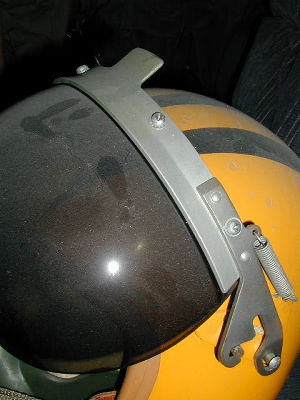
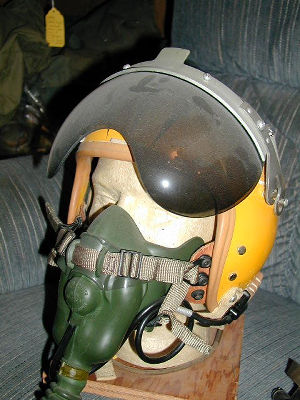
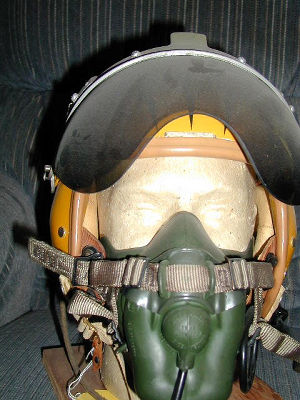
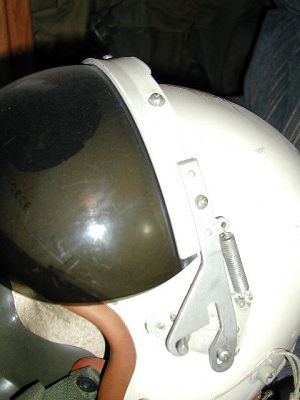
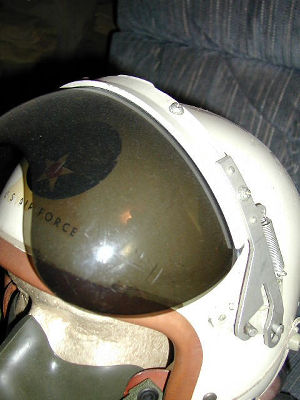
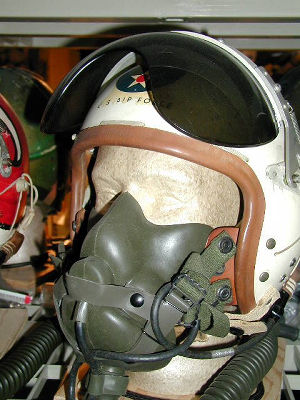
The attached photo images show shots of two P-series helmets. The yellow-shell is a P-3
with the early (short "J" arm side latches), while the white-shell is an early
P-4 with the slightly longer "J" arm side latches. Careful study of the images
will reveal the differences referred to in the "early" and "late" side
latch visors. The center-track (P-4A/P-4B) system is not shown, since it is far more well
known. I tried to reduce the images to the smallest possible file size that would still
allow clarity and resolution, but there are several attached, so be patient and allow them
to download. I hope this information is helpful. Cheers all, DocBoink
Message 845:
> One of you commented on the P4 visor on eBay that it was the late type - how can you
tell?
There are two main types- those without the center track, and those with. Those without
were found on the P-3 and P-4. Additionally, the early visors on the P-3 (those added to a
P-1A to make it a P-3, not the "factory" P-3) did not retract as far upward as
later P-4.
The center-track type were found on P-4A and P-4B. Finally it was possible to EASILY
retract the visor with one hand! I will venure a guess that the USAF decided to have their
contractors follow the design of the Toptex 3BM, which also had a center track, but no
springs.
Rich